 AIFind
Paperguide Review 2026: AI Research With Cited Answers
Paperguide is an AI research workspace that answers questions from 200M+ papers, links each claim to the exact source sentence, and runs literature reviews and PRISMA-style systematic reviews. There is a free plan with 2,000 AI credits a month, and paid plans start at $12 per seat per month billed yearly. It suits students, researchers and review teams.
What Is Paperguide?
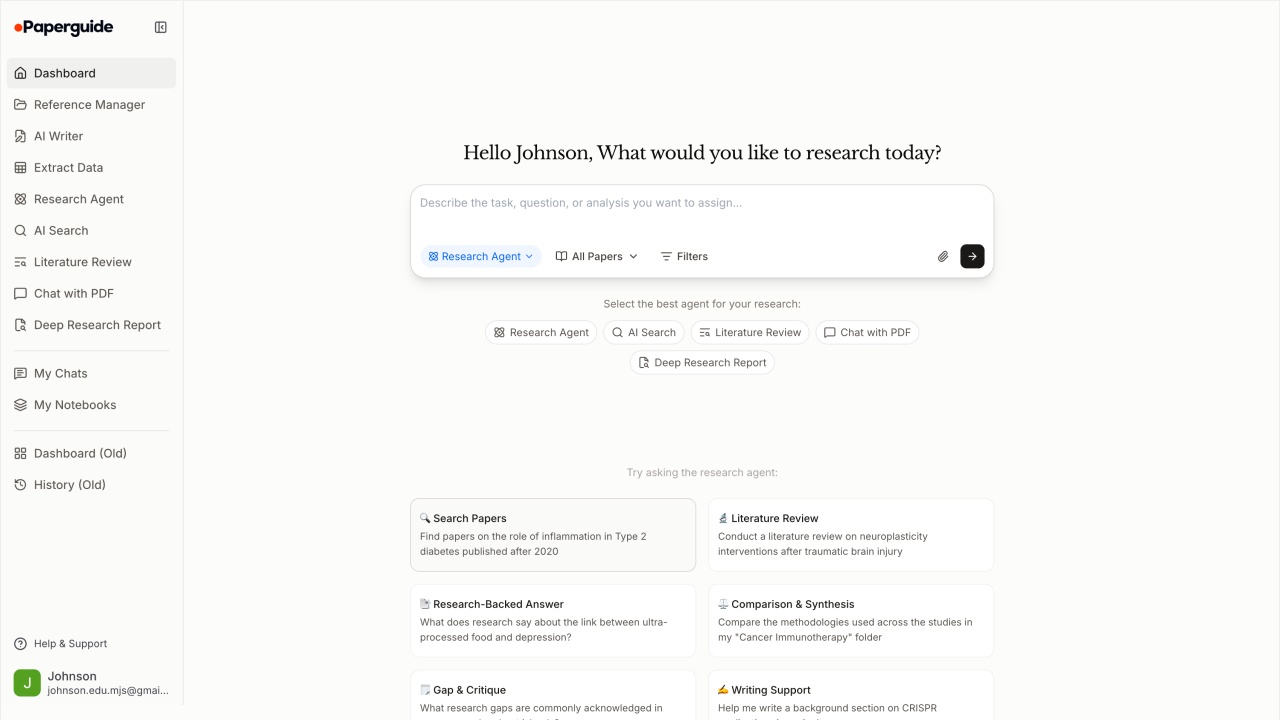
Paperguide puts the steps of a literature workflow in one workspace. You ask a question in plain language, and AI Search returns a synthesized answer from across 200M+ papers drawn from PubMed, arXiv, OpenAlex and Semantic Scholar, plus your own library. Every claim links to the sentence in the source paper it came from, and journal quality signals such as SJR and SNIP appear on results so a weak source stands out before you cite it.
The same library feeds the rest of the product. A reference manager imports from Zotero and Mendeley or by DOI, a Research Agent compares studies and chats with your PDFs, Extract Data turns many papers into a cited table, and an AI Writer drafts text grounded in real literature. A separate Systematic Review module covers protocols, screening and PRISMA reporting.
Key Features
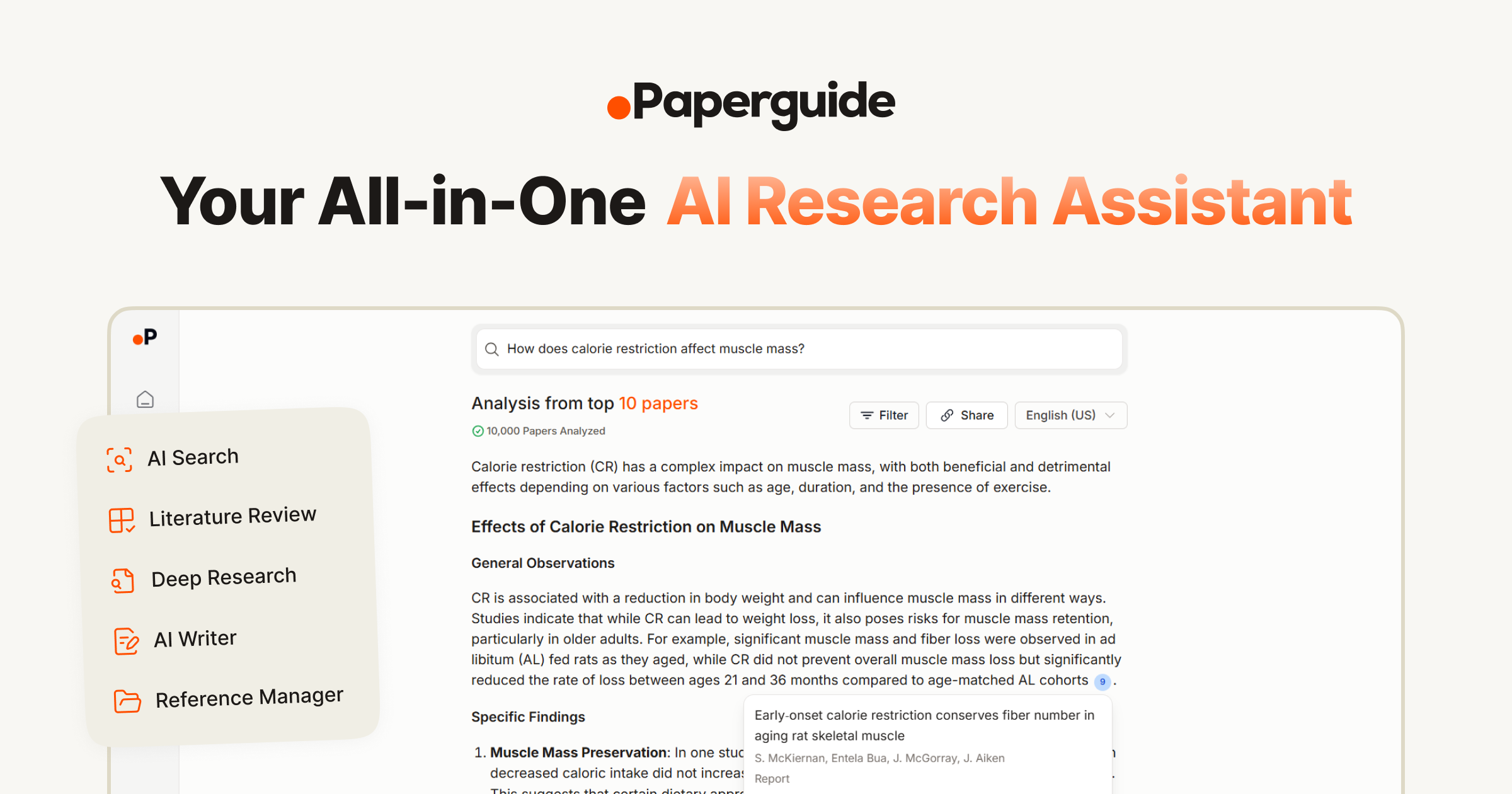
- AI Search across 200M+ papers, with claims linked to the exact source sentence
- Research Agent for multi-step investigation and chat with one or several PDFs
- Literature review generation for up to 50 papers, organized by theme and cited
- Extract Data into a structured table with your own columns, exported to CSV or Excel
- Systematic review with dual-reviewer screening, a conflict resolver and a PRISMA diagram
- Reference manager with Zotero and Mendeley import and annotations
- AI Writer with 1,000+ citation styles, plus a plagiarism checker and a Search API
How a Literature Review Runs
- Ask a research question and read the cited answer.
- Save the useful papers to your library, importing from Zotero, Mendeley or by DOI.
- Set the protocol, then let the Research Agent generate a literature review of up to 50 papers.
- Pull study details into an Extract Data table and check each value against its source.
- Draft in the AI Writer and export references as RIS, BIB or CSV.
Systematic Reviews
Paperguide's systematic review module puts a predefined protocol, documented search, screening decisions and PRISMA flow in one place. In dual-review mode two reviewers screen independently with a conflict resolver, and the AI prepares cited evidence for each criterion instead of making the call. An AI-only mode suits rapid, scoping and internal reviews, with a named verifier confirming each stage. The final decision is always human and on record. PRISMA-grade dual reviewer screening is limited to the Evidence plan and above.
Paperguide Pricing (2026)
| Plan | Billed yearly | Billed monthly | AI credits a month | Systematic reviews |
|---|---|---|---|---|
| Free | $0 | $0 | 2,000 | Not listed |
| Plus | $12 per seat | $19 per seat | 12,500 | Up to 1,000 papers |
| Pro | $29 per seat | $49 per seat | 50,000 | Up to 5,000 papers |
| Evidence | $89 per seat | $149 per seat | 150,000 | Up to 5,000 papers, dual reviewer screening |
| Enterprise | Custom | Custom | Custom | Up to 20,000 papers |
Credits are shared across systematic reviews, research agents, reports and the AI Writer. The Free plan limits extract tables to 5 columns and 10 papers, and Plus and Pro raise that to 50 columns and 100 papers. You can start with Paperguide here.
Paperguide vs Other Research Assistants
| Paperguide | SciSpace | Anara | |
|---|---|---|---|
| Free plan | Yes, 2,000 credits a month | Yes | Yes, limited AI usage |
| Entry paid price | $12 per seat per month, billed yearly | Credit-based Premium, see its pricing page | $8 per seat per month, billed yearly |
| Built around | Source-linked answers plus a full systematic review workflow | Discovering and explaining papers, with an AI writer | Searching 300M+ papers and your own library with passage-level citations |
For a deeper comparison of two alternatives, read SciSummary vs SciSpace.
Pros and Cons
Where it holds up: every claim traces back to a source sentence, the free plan is usable, and the systematic review workflow with PRISMA reporting is more complete than most paper-chat tools. Journal quality signals and Zotero and Mendeley import fit how researchers already work.
Where it falls short: credits are shared across features, so heavy use can run through a plan. Dual-reviewer screening starts at $89 per seat per month billed yearly. GDPR, SOC 2 and ISO 27001 are listed as coming soon, which matters for teams with strict compliance rules, and image and table extraction is still listed as coming soon.
Who Should Skip This
If you only need a quick summary of one paper, a single-purpose summarizer such as SciSummary costs less. If your institution requires certified security today, wait until the compliance badges ship. And no AI tool replaces reading the papers that matter: check important claims against the original source, and treat any synthesized review as a draft.
Similar Tools Available on AIFind
For passage-level citations across a large paper library, see Anara. For AI writing grounded in your own sources, see Jenni. For paper discovery and plain-language explanations, see SciSpace. Browse the Best AI Tools for Academic Research and Best AI Tools With a Free-Forever Plan collections.
FAQ
Is Paperguide free? Yes. The free plan includes 2,000 AI credits a month, limited reference management and AI searches, and small extraction and plagiarism-check limits. Paid plans start at $12 per seat per month billed yearly.
Can Paperguide run a systematic review? Yes. It supports protocols, AI screening with cited evidence, dual-reviewer screening with a conflict resolver, verified extraction and a PRISMA diagram. Dual-reviewer screening is on the Evidence and Enterprise plans.
Does Paperguide invent citations? The company says answers are drawn from real papers and cited to them, with each claim linked to its source sentence. You should still verify important claims.
Can I import my Zotero or Mendeley library? Yes. You can import from Zotero or Mendeley, or add papers by DOI, and metadata and open-access PDFs are fetched for you.
How many papers can a literature review cover? The generated literature review covers up to 50 papers, while systematic reviews scale from 1,000 papers on Plus to 20,000 on Enterprise.
This page may contain affiliate links — AIFind may earn a commission if you sign up through them, at no extra cost to you. See our affiliate disclosure for details.

Paul
Founder & Editor, AIFind
Paul is an experienced Human Resources professional with a background in applying technology, data analytics, and workflow optimization to HR management. Outside his corporate HR career, he's a seasoned content creator and digital entrepreneur: he built a YouTube channel to 60,000+ subscribers over 10 years, ran a print-on-demand e-commerce business on platforms like GearBubble, and actively uses AI tools and automation in both his own projects and enterprise work — the hands-on experience behind AIFind's tool research and reviews.